The value of CE&I: Judgment on the job site

A set of plans can be flawless and still produce a flawed structure if the work in the field drifts from the plans. That gap, between the design on paper and the work on the ground, is where construction engineering and inspection lives. CE&I makes sure what gets built matches what was designed, and that it meets the standards the public will depend on for decades.
CE&I is broader than most people realize
The discipline spans the life of a construction project. Materials testing to confirm that concrete, asphalt, soils, and steel meet specification. Field observation to verify the contractor is building to plan. Documentation that creates a defensible record. Coordination that keeps the parts moving in the right order. It applies on bridges, roadways, drainage systems, water and wastewater facilities, airfields, and nearly any project where the difference between built-to-plan and close-enough carries significant consequence.
That gap doesn't close itself. It takes a team that understands the project from the first preconstruction meeting to final acceptance. A team that builds relationships with contractors, designers, and stakeholders. A team with the technical expertise to recognize issues and the judgment to address them before they become problems. CE&I is often defined by inspections, testing, and documentation, but its real value comes from the people applying that knowledge, making decisions every day in the field.
High-stakes moments
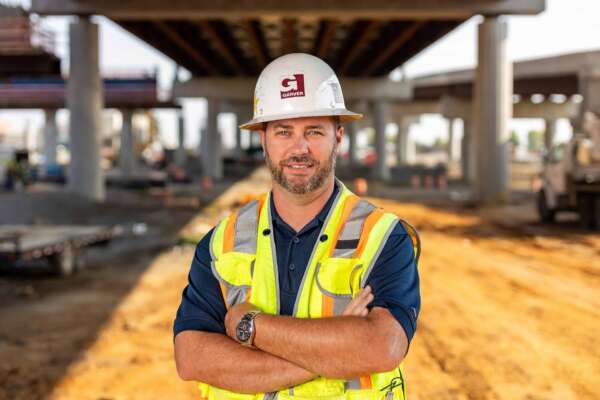
I've spent more than 45 years on construction projects, including 29 years with TxDOT before moving into consulting, and if I had to describe what CE&I really is, I'd point to a bridge deck pour.
To most people, it looks like a few hours of concrete placement. To experienced CE&I professionals, it's the result of weeks of preparation, coordination, and decision-making. Long before concrete arrives, me and my team have verified the deck, coordinated logistics, reviewed risks, and worked through potential issues. By the time the pour begins, much of the project's success has already been determined.
Then preparation meets reality. Concrete has to meet specifications for temperature and consistency when it's placed, because material that goes in out of spec can compromise the strength and durability of the finished structure. The team checks it, load by load. And here is the part that defines the work: when a load falls outside specification, the right call is to reject it, even in the middle of a pour, even when rejecting it is inconvenient and would be easier to wave through.
That moment is CE&I in its purest form. The details vary from project to project, but the responsibility remains the same: protect the owner's investment, uphold the standard, and address problems while they can still be fixed.
Experience is what makes the judgment reliable
Anyone can read a specification. Knowing what it protects, and holding the line under pressure, comes from experience. This is where CE&I teams separate from one another, and where a services list stops telling the story.
Some of the strongest CE&I work is done by people who came up on the owner's side before moving into consulting.
That background is part of what makes a CE&I team a true extension of the owner's staff. With four decades of working on highways, bridges, and airfields across the state, and now backed by a team with almost a century of experience doing the same, we’ve learned what a specification is designed to prevent, because we inspect against it for years and watched what happened when it slipped. We coordinate with the contractor, guide when needed, and hold everyone to the same standard, because the owner trusts us to represent their interests when no one from their office is there to watch. That trust is the product. A signature, an inspection sign-off, a report filed at the end of a long night, they all carry the same promise: a person stood behind this work and is accountable for it.
The measure of success is a structure nobody questions
Good CE&I disappears into the finished project. When the work is done well, none of it is apparent from a passing car. The driver crosses a bridge, travels a road, relies on a system, and thinks nothing of it. That is exactly the outcome the discipline is designed to produce.
Behind it is a team that managed the preparation, embraced the standard, and made the harder call. You can't shortcut the inspection that protects a project, and you can't automate the judgment that catches a problem in real time. The reward for doing it right is infrastructure so dependable it disappears into the background of an ordinary day.






Share this article